Cape Town’s industrial market is full, expensive and still climbing. Vacancies sit near rock bottom, rents keep rising, and after years of waiting, developers are finally breaking ground, provided they can find a site to develop.
Double-Digit Rents, Almost No Empty Space
Rode’s second-quarter 2026 research puts Cape Town’s year-on-year growth in prime rentals for 500 m² premises at about 11.7%. The Central Witwatersrand managed 8.4%, the East Rand 6.4% and Durban 4.6%. Vacancies averaged just 3.3% in the first half of 2026, below the national level of around 3.7% to 3.8%.
2025 was even hotter. One agency reported Cape Town leading the country with roughly 15% year-on-year rental growth, and effectively zero vacancy in nodes such as Airport Industria, Montague Gardens and Blackheath.
Epping Property reports that Industrial Rentals have grown 10.03% compounded over the last 3 years.
Why There’s Nowhere Left to Rent
Land is scarce, and tenants keep coming. Analysts call Cape Town one of South Africa’s most supply-constrained industrial and logistics markets. Online retail and supply chains keep demand strong, and rising replacement costs keep pushing rents past national averages.
The older core may see some relief. Epping Property’s Q3 2026 index shows several large prime premises hitting the market in Epping Industria, which lifted the average asking rental. Availability is still tight, but more vacant space is on its way.
The Builders Arrive
Those rents have changed what developers can afford to do. The Cape Metropole has entered a new phase of accelerating speculative development, a break from how the market traditionally worked. Oasis Crescent Property Fund, which owns mainly Western Cape property, says rentals now support new building. The catch: viable development sites remain finite.
Big Money Is Circling
Capital is following the returns. MSCI’s South Africa Annual Index for December 2025 found industrial property was the top-performing sector and Cape Town the top-performing region. Deals keep coming.
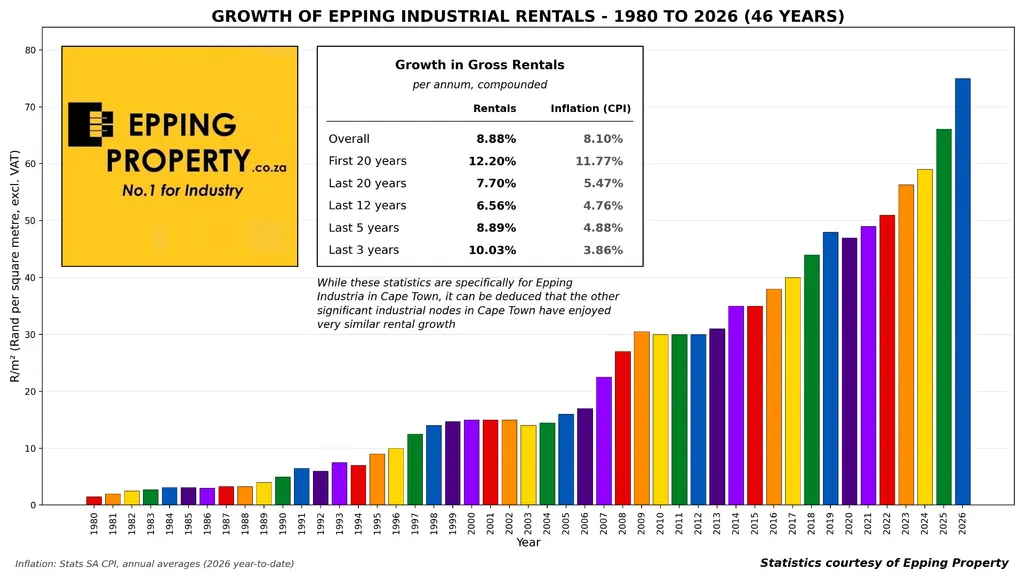
But overpaying is a real risk. Rode’s analysts warn that competition for quality assets makes acquisition pricing critical, and that rental growth alone doesn’t make an investment. MSCI’s data shows wide variation in income growth, so asset selection matters enormously.
What Happens Next
Cape Town is still a landlord’s market as 2026 closes, with low vacancy and double-digit rental growth. That may cool as new space arrives, depending on how quickly speculative projects finish and whether they suit occupiers’ needs. Tenants should plan moves well ahead, because suitable space is hard to find. Buyers should weigh entry prices carefully in a market that has already run hard.